AI Verse trained a YOLO L tank detector on 60,000 synthetic images. In tests with the DGA and Capgemini, it reached an AP50 of 0.85 on real tank imagery.
| Measure | Result |
|---|---|
| AP50 on real tank imagery | 0.85 |
| Training data | 60,000 synthetic images from the AI Verse procedural engine |
| Model architecture | YOLO L |
| Tested with | The DGA and Capgemini |
Can a model trained on synthetic data detect real tanks?
Yes. We trained a YOLO L detector on 60,000 synthetic images. In tests with the DGA and Capgemini, it reached an AP50 of 0.85 on real images of tanks. The model learned from computer-generated scenes and then performed well on real photos.
Why is it hard to train a tank detection model on real data?
Few pictures of tanks exist, and most of those are classified, so labelled training data is scarce. The images that are available rarely cover enough variety: different terrain, light, weather and viewing angles. A model trained on a narrow set of images may work in the lab and fail in the field.
What is synthetic data, and why does it help defence AI?
Synthetic data is computer-generated imagery made to look like the real world. For defence computer vision, it has three advantages:
- Volume: we can generate as many images as a model needs.
- Labels included: every image comes labelled, so no one annotates anything by hand.
- Access: it covers scenes that are too costly, dangerous or sensitive to photograph.
How did we build the synthetic tank dataset?
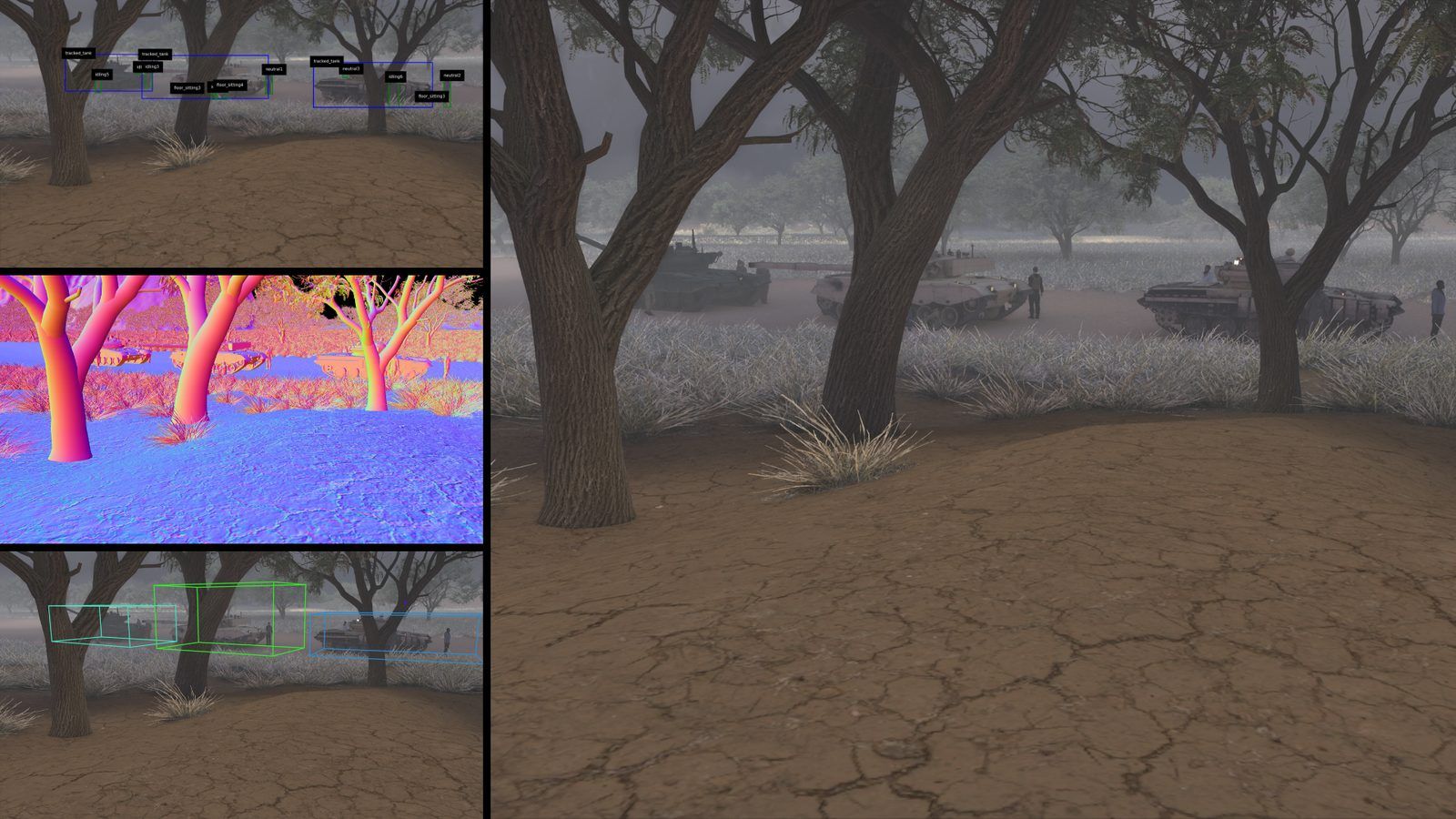
We used the AI Verse procedural engine to generate many types of tank in many settings, with varied terrain, lighting and weather. Users control every part of an image: the environment, the light, the camera lens and the objects in frame. Within those limits, the engine can produce as many images as a model needs.
With that much volume and variety, the model learns what makes a tank a tank instead of memorising the scenes it saw in training. For this project, we generated 60,000 images and trained a YOLO L detector on them.
What does 0.85 AP50 mean?
AP50 (average precision at 50% overlap) measures how well a detector finds objects and places boxes around them. A detection counts as correct when its box covers at least half the area of the real tank’s box. On a scale from 0 to 1, a score of 0.85 means the model found most of the tanks and drew few boxes where there was no tank.
What does this mean for defence teams?
In defence work, the hard part is often getting the data, not designing the model. These results show that a detector trained on synthetic images can perform well on real tank imagery. Teams don’t have to wait for scarce, classified photos or pay to have them labelled.
FAQ
How many synthetic images did you use to train the model?
60,000 images, all generated with the AI Verse procedural engine.
Which model architecture did you use?
YOLO L, the large version of the YOLO object detection family.
Who tested the model?
We tested it with the DGA and Capgemini on real tank imagery.
Does synthetic data need manual annotation?
No. Every synthetic image comes with its labels, so no one has to annotate by hand.
Can synthetic data replace real data for military object detection?
For tank detection, a model trained on synthetic data reached 0.85 AP50 on real images. That makes synthetic data a practical option when real data is scarce or classified.