Choosing between a procedural engine and generative AI is one of the biggest decisions in image creation and computer vision training. Both create artificial images, but they differ in how they work, how much control they give, and what they produce. This guide sets out the main differences, the trade-offs, and where each method fits best.
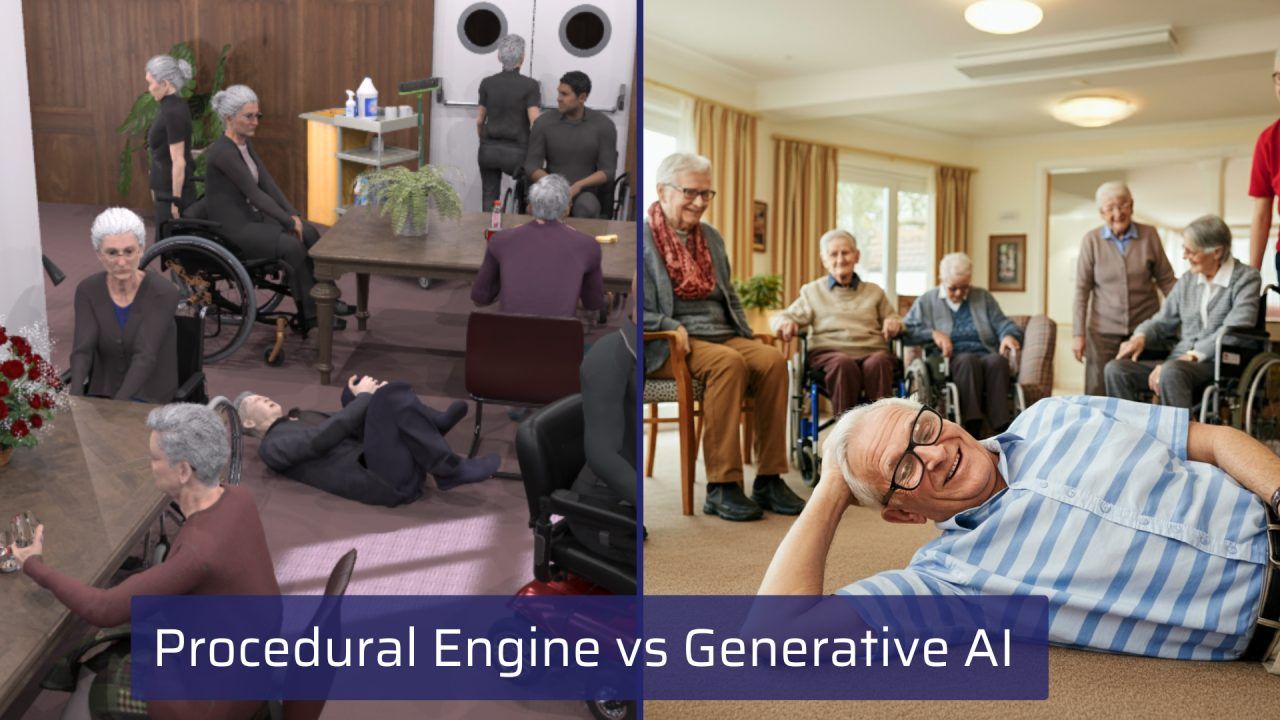
Quick Answer: Procedural Engine vs Generative AI
A procedural engine generates images from rules and fixed mathematical processes. Each image comes from explicit logic, so engineers control labels, scene settings, and object placement precisely. Generative AI instead uses deep learning models (such as GANs or diffusion models) that learn statistical patterns from large image datasets and use them to create new images. Generative AI is strongest at creativity and photorealism; a procedural engine is strongest at control, repeatability, and labeled data.
What Is Generative AI for Image Creation?
Generative AI for image creation refers to machine learning systems, most commonly Generative Adversarial Networks (GANs), Variational Autoencoders (VAEs), or diffusion models like Stable Diffusion and DALL-E, that learn to make images from huge collections of real photographs or artwork. During training, these models absorb visual patterns, textures, lighting, and composition, then recombine them into new images.
Because they learn from data, generative models can produce highly realistic, varied, and creative images from little input; a short text prompt can produce a photorealistic scene. But that flexibility makes them unpredictable: the model decides scene content, object positions, and visual details itself, and the user cannot always control them.
Key characteristics of generative AI:
- Trained on large real-world datasets (millions of images)
- Produces diverse, novel, and often photorealistic outputs
- Limited fine-grained control over specific scene elements
- Outputs vary from run to run (the same prompt can give different results)
- Labels are not generated automatically and must be added separately
- High computational cost, especially at training time
What Is a Procedural Engine for Image Creation?
A procedural engine generates images from coded rules that define every visual element in a scene. Unlike generative AI, it does not learn from data; it runs a fixed process controlled by settings that engineers choose. Code controls objects, backgrounds, lighting, weather, and camera angles.
AI Verse’s procedural engine, for example, lets computer vision teams set exactly which objects appear in a scene, how far away they are, the lighting, how much of each object is hidden, and the weather, then generate thousands of fully labeled images in hours. The result is a controlled, scalable dataset, labeled and ready for training computer vision models.
Key characteristics of procedural AI:
- Rule-based, algorithmic image generation (no training data required)
- Fully deterministic and repeatable outputs
- Exact control over every visual parameter (lighting, angle, object placement, scene complexity)
- Automatic pixel-perfect annotations and labels generated alongside images
- Scales easily: generates millions of labeled images quickly
- Built to simulate edge cases and rare scenarios
Procedural Engine vs Generative AI: Core Differences
The table below sums up the main differences between the two approaches:
| Dimension | Procedural engine | Generative AI |
|---|---|---|
| How it works | Rule-based algorithms with defined parameters | Deep learning models trained on real image datasets |
| Control | Exact (every element is programmable) | Approximate (guided by prompts, but AI decides details) |
| Repeatability | Fully deterministic (same inputs produce same outputs) | Stochastic (same prompt yields different results) |
| Annotation | Automatic, pixel-perfect labels generated with images | Manual annotation required after generation |
| Data requirements | No training data needed | Requires millions of captioned training images |
| Creativity | Constrained by defined rules | High (can produce unexpected, novel compositions) |
| Best for | Computer vision training data, edge case simulation | Creative content, concept art, design exploration |
| Scalability | Extremely high (millions of images per run) | Moderate (slower per image at high quality) |
| Computational cost | Low at generation time | High (especially during model training) |
Control and Predictability
Control is the procedural engine’s main advantage over generative AI. With a procedural engine, computer vision engineers define the exact parameters of every generated scene: the number and class of objects, their 3D position and orientation, the lighting conditions, the camera focal length, background environment, and even the level of motion blur or lens distortion. This control lets teams generate images aimed at a model’s specific failure modes: the rare scenarios that real-world data collection almost never captures.
Generative AI allows users to guide image generation through text prompts, but the model still decides how to interpret them. Two prompts that differ by one word can produce very different images. Object placement, proportions, and scene logic all follow patterns the model learned in training, and those patterns may not match the precise requirements of a computer vision dataset.
For teams building safety-critical computer vision systems, such as autonomous drones, warehouse robots, or military surveillance, a procedural engine gives repeatable, auditable results that generative AI cannot reliably provide.
Flexibility and Creativity in Image Outputs
Generative AI beats a procedural engine when creativity and visual novelty are the main goals. Generative models can produce images with complex aesthetic qualities, subtle lighting interactions, and imaginative compositions that would be impractical to define with explicit rules. This makes generative AI ideal for digital art, advertising imagery, game concept art, and creative exploration.
A procedural engine is less free-form, but it is far more flexible when the goal is to cover a defined range of conditions systematically. A procedural engine can generate images across thousands of combinations of weather (rain, fog, snow, bright sun), time of day, sensor types (RGB, infrared, depth), and object layouts, all automatically, all labeled, and all at scale.
Data Requirements and Training Infrastructure
The two approaches also differ in how much data they need. Generative AI needs huge volumes of training data, often millions of labeled images, before it can produce usable output. So a generative system can be no better or more varied than its training set, and it repeats, and sometimes amplifies, the biases in that data.
A procedural engine has no such dependency. Because it works from rules rather than learned patterns, it can create data for scenarios no one has ever photographed. This is especially valuable in defence, industrial automation, and other domains where real-world training data is scarce, expensive to collect, or legally sensitive.
Applications in Computer Vision Model Training
For computer vision teams, the choice between the two directly affects the quality and efficiency of model training. A procedural engine is the preferred way to generate synthetic training data because it solves the three main problems with real-world data: scarcity, the labeling burden, and poor edge case coverage.
Teams increasingly use generative AI to add visual variety to real or procedural datasets. But without automatic labels, generative images need a lot of manual labeling before they can go into supervised learning pipelines.
AI Verse’s procedural engine closes this gap. It generates fully labeled, photorealistic synthetic images at the scale needed to train production computer vision models, without the labeling bottleneck that generative AI creates.
Why Procedural Engine Excels for Synthetic Training Data
For generating synthetic training data, a procedural engine has five clear advantages over generative AI:
- Automatic annotation: Every generated image comes with pixel-perfect bounding boxes, segmentation masks, depth maps, and class labels, ready to use in training pipelines right away.
- Edge case simulation: Teams can generate rare but critical scenarios at scale, such as objects partly hidden by fog, vehicles in low light, or targets at extreme angles.
- Domain coverage: Engineers can cover every condition of a deployment environment, so the model stays reliable in all of them.
- No domain gap from mislabeled data: Because code generates labels alongside the images, there are no labeling errors.
- Speed and cost: Teams can generate millions of labeled images in hours, at a fraction of the cost of manual data collection and annotation.
Conclusion: Choosing Between Procedural Engine and Generative AI
The right choice depends on your goal. For creative, varied images for art or marketing, generative AI offers more flexibility and visual range. For scalable, precisely controlled, automatically labeled images to train computer vision models, a procedural engine is the better choice.
AI Verse’s procedural engine combines the control and labeling precision of rule-based generation with the variety needed to train reliable, production-ready computer vision models. Teams building safety-critical systems, from defence drones to industrial robots, choose it for the data quality, coverage, and auditability that generative AI cannot reliably deliver.
For computer vision teams that want more training data without higher labeling costs, a procedural engine is not just an alternative to generative AI. It is built for the job.
Frequently Asked Questions: Procedural Engine vs Generative AI
What is the main difference between procedural engine and generative AI?
The main difference is how they create images. A procedural engine uses rules in which engineers set every visual parameter, so its output is repeatable and fully labeled. Generative AI uses deep learning models trained on real images to create new ones from learned patterns, which gives more creative freedom but less control.
Is procedural engine better than generative AI for training computer vision models?
Yes. A procedural engine is generally better for computer vision training data because it labels images automatically, covers edge cases systematically, and is fully controllable. Generative AI can add to training datasets, but it needs extra labeling and gives less control over scene content.
Can generative AI produce labeled training data automatically?
No. Generative AI models do not automatically generate annotation labels (bounding boxes, segmentation masks, class labels) alongside images. Someone must add labels by hand or through a separate labeling pipeline. A procedural engine, by contrast, generates labels as part of creating each image.
What is a procedural engine in the context of AI?
A procedural engine is software that generates synthetic images and data from fixed rules and settings, not from patterns learned from real-world data. In AI training, teams use procedural engines like AI Verse’s to create large-scale, automatically labeled synthetic image datasets for training computer vision models.
Which approach requires more computational resources?
Generative AI needs far more computing power, especially during training, which means processing millions of images over thousands of GPU hours. A procedural engine is lighter because it uses rendering rather than neural networks.
Can procedural engine and generative AI be used together?
Yes. Computer vision pipelines increasingly combine them: a procedural engine generates the core labeled dataset with full control, and generative AI adds visual variety and realistic textures. Together they can help models handle new scenes while keeping labels accurate.
What industries benefit most from procedural engine for image generation?
Industries that most need large, controlled, labeled image datasets benefit most. They include defence and surveillance (drone detection, perimeter monitoring), autonomous vehicles, industrial inspection, smart building security, and any computer vision application where real-world data collection is dangerous, expensive, or legally restricted.