In computer vision today, the lack of accurately labeled data is still one of the biggest bottlenecks. Manual labeling is costly, slow, and inconsistent, and in many projects it eats up over 90% of the resources. Synthetic images with automatic labels fix this by producing huge volumes of precisely labeled images. Training gets faster, costs fall, and teams can cover scenes that are hard or impossible to capture in real data.
Synthetic Data Generation Methods for High-Fidelity Annotations
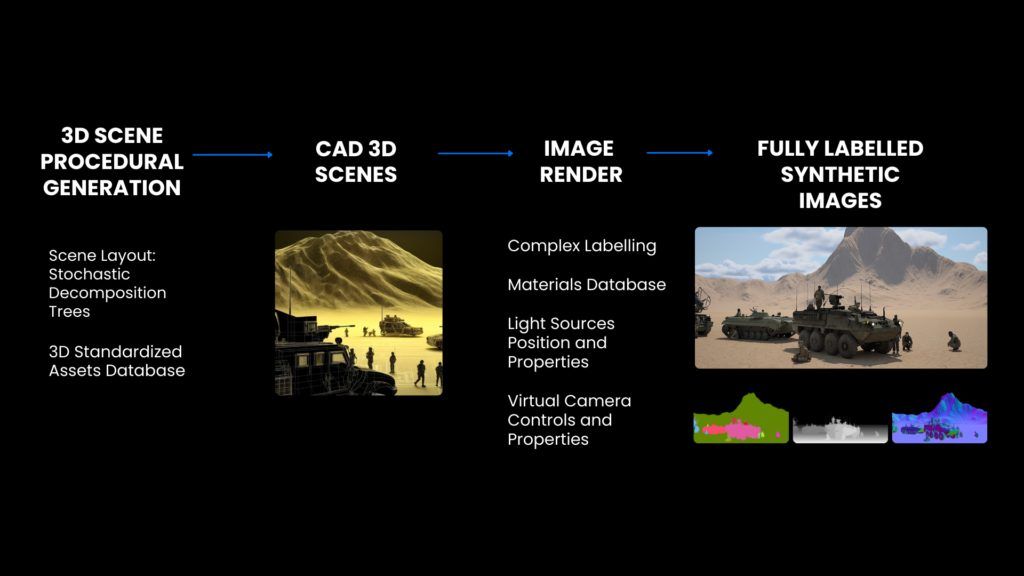
Simulation engines create labeled training images with no manual input. The leading approach is the procedural engine. AI Verse’s procedural engine, GAIA, renders full environments with simulated lighting and sensors, and produce large datasets with pixel-perfect labels such as 3D bounding boxes, depth maps, and classes.
This method quickly creates varied, richly labeled datasets for specific computer vision tasks, so teams rely less on expensive, error-prone manual labeling without giving up scale or precision.
Core Benefits of Synthetic Image’s Automated Annotation
Synthetic data with automatic labels gives computer vision engineers several advantages:
- High Label Accuracy and Consistency: Automatic labeling removes human error and bias, and produces the precise pixel-level labels that high-quality models need.
- Complex Annotation Generation: Synthetic data cheaply provides labels that are usually expensive or hard to get, such as 3D poses, depth maps, and multi-sensor data (infrared, LiDAR).
- Data Diversity and Scalability: Synthetic datasets can simulate rare, dangerous, or edge-case scenes at scale, so models handle more situations than real-world data alone allows.
- Accelerated Iteration Cycles: Teams can regenerate and relabel datasets quickly, so they can test more ideas and improve and deploy models sooner.
- Bias Mitigation and Data Balancing: Synthetic data can fill out classes or groups that real datasets often underrepresent.
Real-World Applications:
Automatic labeling with synthetic data matters more and more in many computer vision fields:
- Autonomous Systems: Drone vision models train on synthetic datasets that combine several sensor types, so they can navigate and detect objects reliably in many flying conditions.
- Counter-Unmanned Aerial Systems (Counter-UAS): Synthetic aerial threat scenarios help teams train systems to detect, classify, and counter drones.
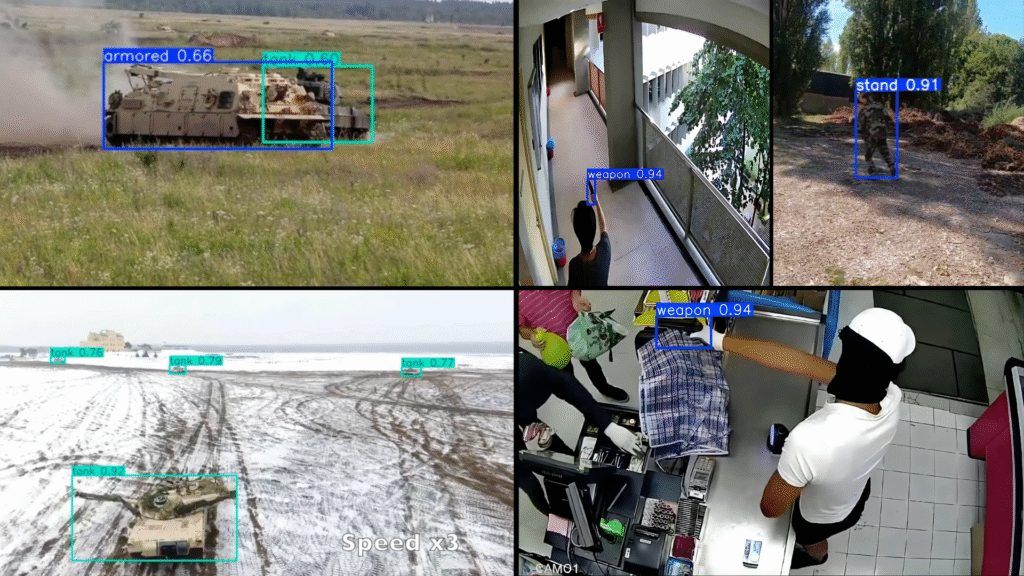
- Surveillance and Security: Synthetic surveillance datasets train detection and behavior-analysis models for poor light, bad weather, and partly hidden subjects.
- Robotics: Synthetic environments provide labeled data for robots that move, handle objects, and interact, which speeds up work on warehouse, inspection, and service robots.
Newer fields such as retail analytics and augmented reality also benefit.
Industry Trends and Future Advances
The spread of synthetic data fits several 2025 trends toward AI development that scales and protects privacy:
- Hybrid Training Pipelines: Mixing synthetic and real data is now standard practice for the most accurate, reliable models, and studies show it improves precision and recall.
- MLOps Integration: Teams now build synthetic data and automatic labeling into their model pipelines, so they can update datasets and tune models quickly.
- Domain Adaptation Research: New techniques narrow the gap between synthetic and real data, so models trained on synthetic images work better in the real world.
- Bias and Fairness Initiatives: Synthetic datasets help make models more balanced and representative, which helps meet ethical and legal requirements.
AI Verse: Elevating Synthetic Image Generation for AI Training
At AI Verse, we use procedural generation to make high-quality synthetic images built for AI training. Our engine lets users generate custom datasets with pixel-perfect labels on demand, in as little as four seconds per image per GPU. Users control the environment, lighting, objects, sensors, and more, so each dataset matches the project.
AI Verse’s synthetic images include detailed label types such as classes, instances, depth, normals, and 2D/3D bounding boxes, which removes most of the errors of manual labeling. And because they contain no real-world data, our datasets raise no privacy concerns.
Summary
Synthetic data with automatic labels produces precise, varied datasets at scale. It speeds up development, cuts costs, and covers what real data can’t. It already matters in autonomous systems, robotics, surveillance, and beyond, and its role in AI will keep growing.
AI Verse builds customizable tools that generate synthetic training images quickly and to a high standard.