
How Automated Annotation with Synthetic Data Elevates Model Training in Computer Vision
Automated annotation is the process of generating ground truth labels for training data — bounding boxes, segmentation masks, keypoints — without manual human input. With synthetic images, every annotation is produced automatically at the moment of image creation, making it possible to build fully labeled datasets at machine speed and unlimited scale.
What is automated annotation in computer vision?
In traditional workflows, a human annotator must draw and verify each label for each image. At scale, this becomes prohibitive: a single high-quality segmentation mask can take several minutes, and a dataset of 100,000 images may require months of specialist labor.
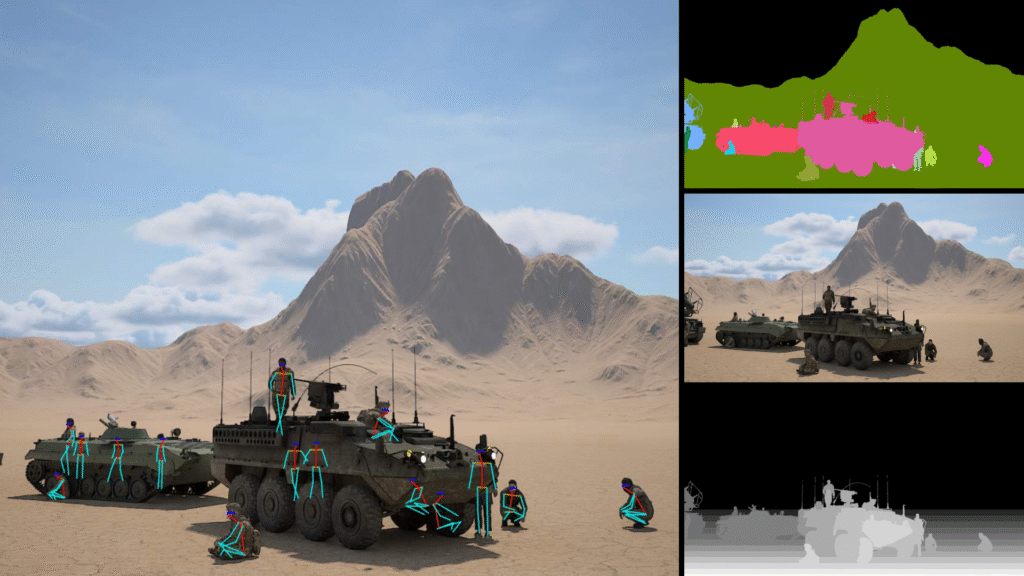
Synthetic image generation solves this by producing images and their annotations simultaneously. Because the rendering engine controls every element of the scene — object identity, position, occlusion, and material properties — it outputs complete, pixel-perfect annotation data as a byproduct of image creation. The result is a fully labeled dataset generated in hours rather than months, at consistent quality and unlimited scale.
In contemporary computer vision development, the shortage of accurately labeled data remains one of the most persistent bottlenecks. Manual annotation is costly, slow, and prone to inconsistency, consuming over 90% of many project resources. Synthetic image generation combined with automated annotation offers a powerful solution by producing massive volumes of precisely labeled images. This accelerates training, reduces costs, and unlocks access to scenarios hard or impossible to capture in real-world data.
Synthetic Data Generation Methods for High-Fidelity Annotations
Synthetic data is generated using various techniques and simulation engines that create labeled training examples without relying on manual input. Leading approach in the domaine is a Procedural Engine. Tools like AI Verse Procedural Engine Helios and Gaia create fully rendered environments with lighting, and sensor simulation, enabling vast datasets creation with pixel-perfect annotations such as 3D bounding boxes, depth maps, and classes.
This method enable the rapid creation of diverse, richly annotated datasets tailored for specific computer vision tasks, reducing reliance on expensive and error-prone manual labeling while ensuring scalability and precision.
Core Benefits of Synthetic Image’s Automated Annotation
Synthetic data generation with automated annotation allows computer vision engineers to gain several critical advantages:
- High Label Accuracy and Consistency: Automated annotation eliminates human error and subjective bias, producing precise pixel-level labels indispensable for training high-quality models.
- Complex Annotation Generation: Annotations traditionally expensive or difficult to obtain, such as 3D poses, depth maps, and multi-sensor fusion data (infrared, LiDAR), can be generated efficiently.
- Data Diversity and Scalability: Synthetic datasets can simulate rare, hazardous, or edge-case scenarios at scale, enhancing model generalization and robustness beyond limitations of real-world data collection.
- Accelerated Iteration Cycles: Rapid synthetic dataset regeneration and annotation support agile experimentation, enabling faster model refinement and deployment.
- Bias Mitigation and Data Balancing: Synthetic data can be engineered to better represent underrepresented classes or demographics, addressing imbalance common in real datasets.
Real-World Applications:
Automated annotation with synthetic data is increasingly critical across multiple computer vision domains:
- Autonomous Systems: Computer vision models for drones rely on synthetic multi-modal datasets combining various inputs to train robust navigation and object detection in diverse flying conditions.
- Counter-Unmanned Aerial Systems (Counter-UAS): Generating diverse aerial threat scenarios synthetically aids in detection, classification, and threat mitigation strategies.
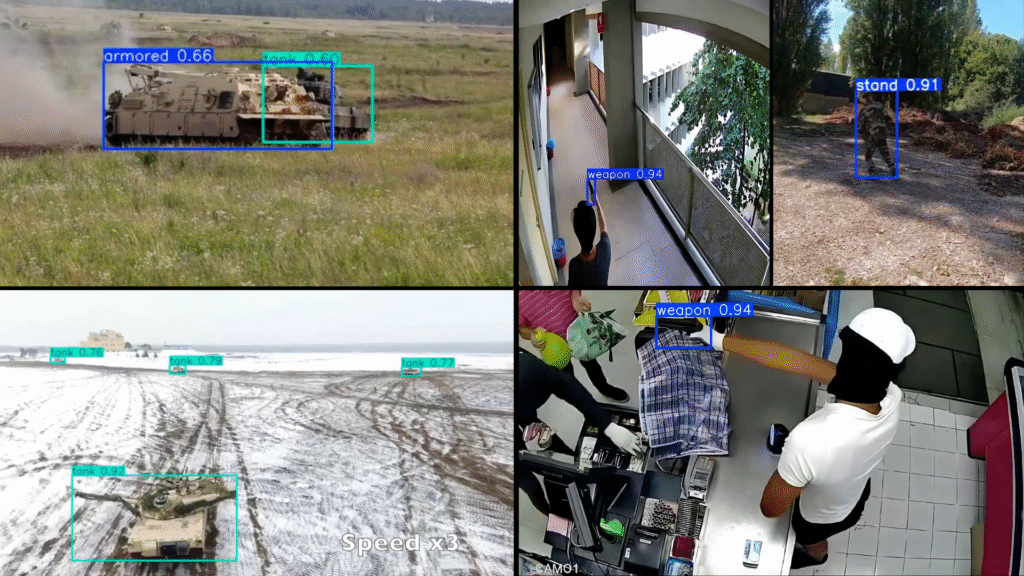
- Surveillance and Security: Comprehensive surveillance datasets enable training of detection and behavioral analysis models under challenging lighting, weather, and occlusion scenarios.
- Robotics: Synthetic environments provide annotated data for robotic navigation, manipulation, and interaction tasks, accelerating development for warehouse automation, inspection, and service robots.
Emerging sectors such as retail analytics and augmented reality also benefit from synthetic annotations, illustrating broad cross-industry relevance.
Industry Trends and Future Advances
The widespread adoption of synthetic data aligns with key 2025 industry trends emphasizing scalable, privacy-conscious AI development:
- Hybrid Training Pipelines: Combining synthetic and real data is now best practice for maximizing model accuracy and robustness, backed by empirical studies showing improved precision and recall metrics.
- MLOps Integration: Synthetic data generation and automated annotation are increasingly integrated into continuous model development pipelines, facilitating rapid dataset updates and iterative tuning.
- Domain Adaptation Research: Techniques to bridge synthetic and real data characteristics reduce distribution gaps, enhancing real-world model transferability.
- Bias and Fairness Initiatives: Synthetic datasets contribute to more balanced and representative AI models, addressing ethical and regulatory requirements.
AI Verse: Elevating Synthetic Image Generation for AI Training
At AI Verse, we harness procedural generation technology to provide high-quality synthetic images tailored specifically for AI training needs. Our proprietary engine enables users to generate fully customizable, pixel-perfect labeled datasets on demand in as little as four seconds per image per GPU. Users control environment settings, lighting, objects, sensors, and more, ensuring datasets precisely match project requirements.
AI Verse’s synthetic images include detailed label types such as classes, instances, depth, normals, and 2D/3D bounding boxes, drastically reducing inaccuracies and human error present in manual annotation. Importantly, our synthetic datasets avoid privacy concerns inherent to real-world data, enabling safer AI training.
Summary
Automated annotation empowered by cutting-edge synthetic data generation techniques enables precise, scalable, and diverse dataset creation that accelerates development, reduces costs, and overcomes the limitations of real data. Its critical role spans autonomous systems, robotics, surveillance, and beyond, positioning synthetic data as an indispensable asset for sophisticated AI applications today and into the future.
AI Verse’s innovative synthetic image solutions stand at the forefront of this advancement, providing powerful, customizable tools designed to meet the highest standards of AI training data quality and efficiency.
Frequently Asked Questions
How accurate is automated annotation compared to human annotation?
In synthetic datasets, automated annotation is pixel-perfect by definition — because labels are generated from exact scene geometry rather than human estimation, there is zero label error. For real-world images, AI-assisted pre-labeling with human review typically achieves 95–99% accuracy, while fully automated methods without review vary depending on image complexity and object class.
How much time does automated annotation save compared to manual labeling?
Manual segmentation annotation can take 5–30 minutes per image depending on object complexity. Automated annotation via synthetic generation produces equivalent labels in milliseconds — as a byproduct of image creation. For a dataset of 100,000 images, manual annotation represents months of specialist labor; synthetic automated annotation achieves the same output in hours. Pipelines using AI-assisted pre-labeling typically cut manual review time by 60–80%.
What annotation types can be generated automatically with synthetic data?
Modern synthetic image generation platforms can produce up to 8 annotation types simultaneously at render time: 2D bounding boxes, 3D bounding boxes, semantic segmentation masks, instance segmentation, depth maps, surface normals, optical flow, and keypoints. All are generated from exact scene geometry with pixel-level precision — without any manual labeling step — making synthetic data the most scalable route to complete, high-quality annotation coverage.
AI Verse and Soloma Avionics are Finalists for DAIC Partnership of the Year Award
Recognizing joint innovation in thermal UAV detection for frontline defense When AI Verse and Soloma Avionics began working together, our shared goal was clear: improve thermal detection performance where it matters most – saving lives in Ukraine. Our partnership has now been recognized by the Defence AI Council as the Finalists for Partnership of the Year award. […]

How Synthetic Images Power Edge Case Accuracy in Computer Vision
Edge cases in computer vision are rare, atypical, or safety-critical scenarios that AI models fail to detect reliably because they appear too infrequently in real-world datasets — a camouflaged vehicle in fog, a pedestrian emerging at night, or a partially occluded object. Synthetic image generation makes it possible to produce and annotate these rare scenarios […]

How to Build Better Computer Vision Models
Computer vision (CV) is revolutionizing industries such as smart home, security, and defense. From enabling fall detection to powering detection of weapons, CV applications are reshaping the way we interact with technology. However, achieving high-performing CV models remains a challenging task due to the dependency on high-quality, diverse datasets. Explore how synthetic images can address […]