
POWERING SMART HOMES
Synthetic Images for Smart Home Applications

Streamlined Training Process
Synthetic images for smart home applications require a new approach to data generation. Say goodbye to the limitations of traditional image sourcing. Our Procedural Engine accelerates the training process by providing a vast array of images, ensuring your models are robust and well-equipped for real-world applications.

Why Choose AI Verse for Smart Home Applications?
AI Verse Procedural Engine generates high-quality images specifically designed to train computer vision models for smart home applications. Our innovative technology ensures your models are equipped with the diverse and accurate data they need to perform seamlessly.

Smart Home Integration
Designed specifically for Smart Home technologies, our generated images cater to various scenarios and environments. This ensures that your models can effectively recognize and respond to everyday situations.
High Image Customizability
Tailor image attributes such as lighting, angles, camera lense and objects to match specific requirements for your smart home applications.
Why Synthetic Images for Smart Home Applications?
Synthetic images for smart home applications are transforming how AI developers train computer vision models. Instead of spending months collecting and annotating real-world footage, teams using AI Verse can generate fully labelled synthetic datasets in hours at any scale, in any scenario, with complete privacy compliance.
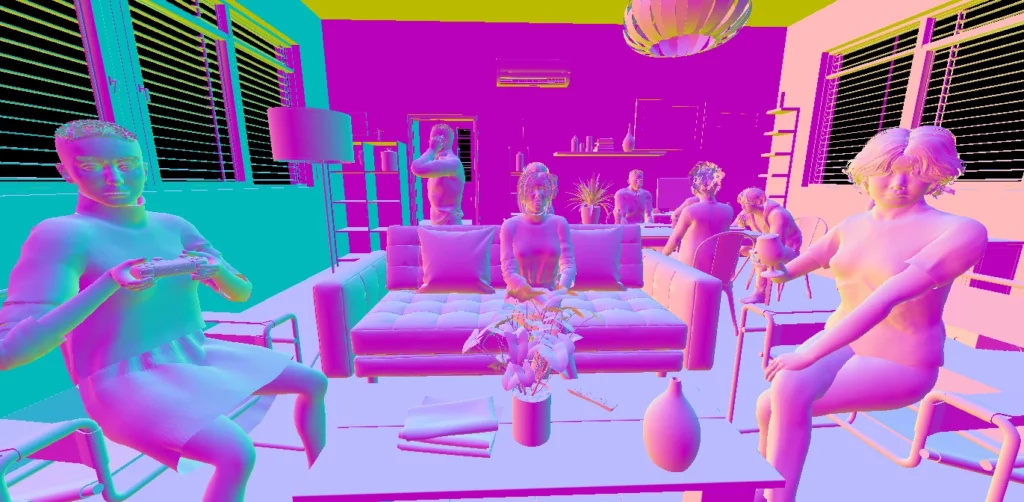
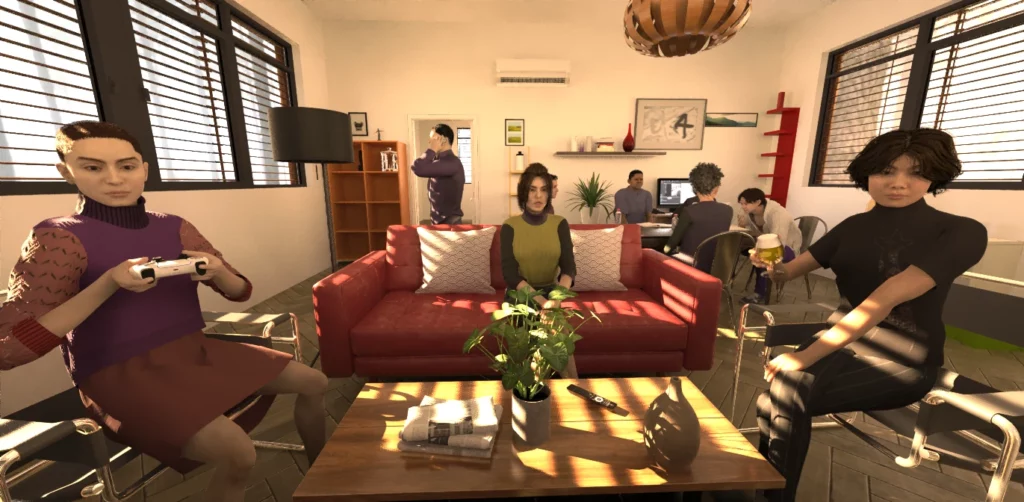
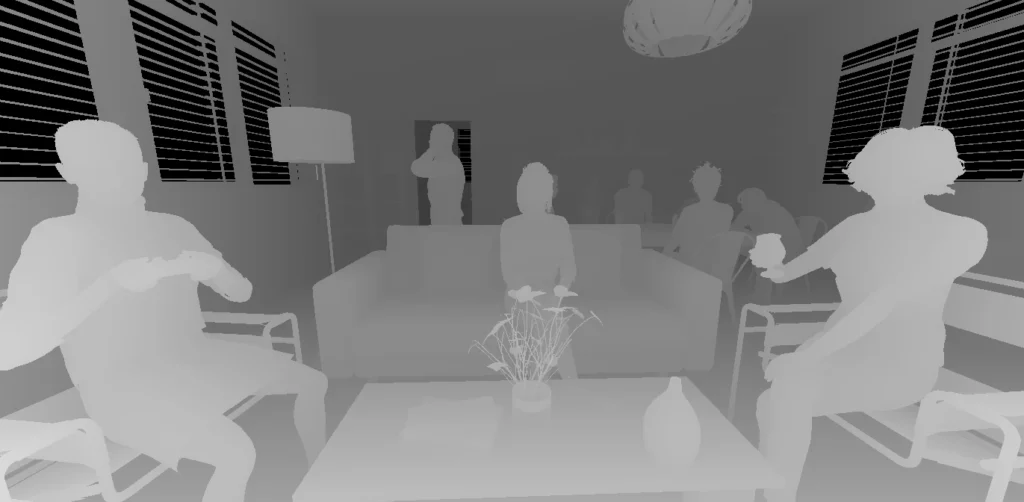
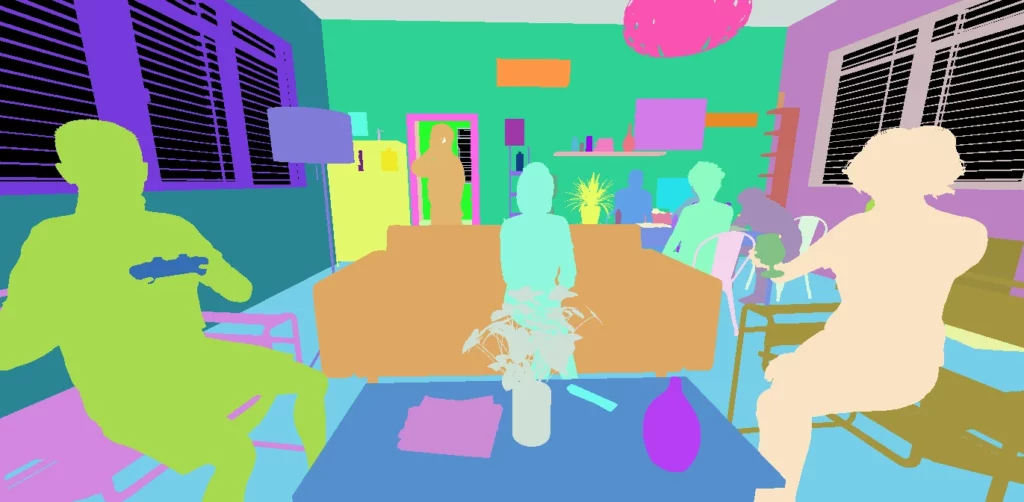
High Quality Images For Smart Home
Personal / Service RoboticS
- Room type detection (kitchen, bedroom, etc.)
- Floor type detection
- Wire or electric cable detection
- Thick rug detection
- Chair leg detection
- Cat litter box detection
- Human foot detection
- Toy detection
- Activity detection: people reading, people sleeping, children playing on the floor, etc.

AR Devices
- Room geometry understanding
- 3D from 2D conversion
- Plane detection
- Hand tracking
- Object detection
- Person detection
- Activity recognition, e.g., a person grabbing, using, or releasing an object, opening or closing a drawer, watching TV, cooking, etc.

Smart Assistants / Surveillance Cameras
- Room type detection
- Object detection / scene understanding
- Person detection
- Activity recognition for improved interaction, e.g., people eating, drinking wine, chatting, reading, preparing coffee, cooking, working, sleeping, etc.
- Intrusion detection (security)
- Detection of people in distress (e.g., people fallen on the floor or from their bed).

Why Choose AI Verse
Improved Accuracy
Enhanced training with diverse synthetic images leads to precise detection and classification of objects.

Reduced Costs and Accelerated Development
Synthetic data reduces the time and cost associated with real-world data acquisition, enabling faster model development and innovation.

Increased scalability
Rapidly generate large volumes of training images and update models quickly and cost-effectively, reducing time to market for your AI solutions.

Improved Privacy
Our advanced image generation technology ensures privacy and compliance by using synthetic images, eliminating the need for personal data and safeguarding user information.

Use Cases
Our synthetic images has been successfully used to train various AI models:
Fall detection from a surveillance camera
Human detection from a service robot
Frequently Asked Questions
What are synthetic images for smart home applications?
Synthetic images are computer-generated visuals created to simulate real-world environments. For smart home applications, this means generating photorealistic scenes of living rooms, kitchens, bedrooms, and outdoor spaces populated with objects, people, and events that a smart home AI needs to recognise. AI Verse’s GAIA platform produces fully annotated synthetic datasets tailored for every smart home use case.
Why use synthetic images instead of real images for smart home AI training?
Real image collection for smart home applications is slow, expensive, and raises serious privacy concerns. Synthetic images for smart home applications overcome all three barriers: they can be generated at scale in hours, cost a fraction of real data collection, and are fully privacy-compliant because no real individuals are captured. Models trained on high-quality synthetic data achieve accuracy comparable to those trained on real-world footage and surpass them when rare edge cases are included.
How do synthetic images improve smart home AI model accuracy?
Synthetic images allow developers to include rare, critical edge cases, such as unusual lighting conditions, uncommon body positions, cluttered domestic environments; that would be nearly impossible to capture naturally at scale. AI Verse generates diverse synthetic scenarios ensuring models perform reliably across all real-world conditions, making smart home AI smarter and safer.
Are synthetic images for smart home applications privacy-compliant?
Yes. Synthetic images contain no real people or private spaces, making them fully GDPR and CCPA compliant by design. This is a critical advantage for smart home applications, where data collection often involves sensitive footage inside people’s homes. AI Verse’s synthetic data pipeline eliminates privacy risk entirely: no consent forms, no data retention issues.
What smart home use cases benefit most from synthetic image training data?
Synthetic images for smart home applications are particularly valuable for training AI in: fall detection and elderly care monitoring, smart security cameras with person and object recognition, AR and mixed-reality home interfaces, robotic assistants navigating domestic environments, and energy management systems using occupancy detection. AI Verse’s HELIOS rendering engine simulates all these scenarios with photorealistic precision.
How quickly can I get synthetic image datasets for smart home AI?
With AI Verse, synthetic datasets for smart home applications are ready in hours, not months. Traditional data collection process, inluding hiring annotators, capturing footage, cleaning labels, take months and cost tens of thousands of dollars. AI Verse automates the entire process, delivering fully labelled, production-ready datasets on demand. For context on the broader industry shift, see NVIDIA’s research on synthetic data for computer vision.
What makes AI Verse the best platform for synthetic images for smart home applications?
AI Verse combines photorealistic rendering, automated pixel-perfect annotation, and domain-specific smart home scene libraries into one platform. Our models understand the spatial and semantic context of domestic environments: furniture layouts, human activities, lighting conditions, and device interactions. The result is synthetic training data that rivals real-world footage in quality, at a fraction of the cost and time. Explore Helios to see how AI Verse can accelerate your smart home AI development.