
How to Convince Your Team to Invest in Synthetic Image Datasets
Transitioning from real-world data to synthetic datasets isn’t always easy, especially for teams that have relied on conventional methods for years. The most common objections include:
- “Synthetic data doesn’t look real enough.” Concerns arise about whether AI models trained on synthetic images can generalize effectively to real-world scenarios.
- “Can we trust synthetic data for critical applications?” Skepticism remains regarding the accuracy and reliability of models trained with synthetic datasets.
- “We’ve always done it this way.” Cognitive bias and resistance to change can slow adoption, even when synthetic data offers clear advantages.
The Case for Synthetic Data
1. Faster, Cost-Effective Data Generation
Real-world data collection is slow and costly, often requiring extensive fieldwork and manual annotation. Synthetic datasets, on the other hand, can be generated within hours. Procedural engines create realistic, labeled images automatically, eliminating the need for manual annotation and ensuring pixel-perfect labels.

2. Improved Coverage of Edge Cases
Traditional datasets often lack representation of rare events, leading to AI models that struggle in critical scenarios. Synthetic data allows precise control over edge case scenarios, such as:
- Nursing homes: Training perception models to recognize people falling on the floor, making sure that model works even in crowded spaces.
- Security AI: Generating adversarial scenarios to test robustness against spoofing attacks in facial recognition.
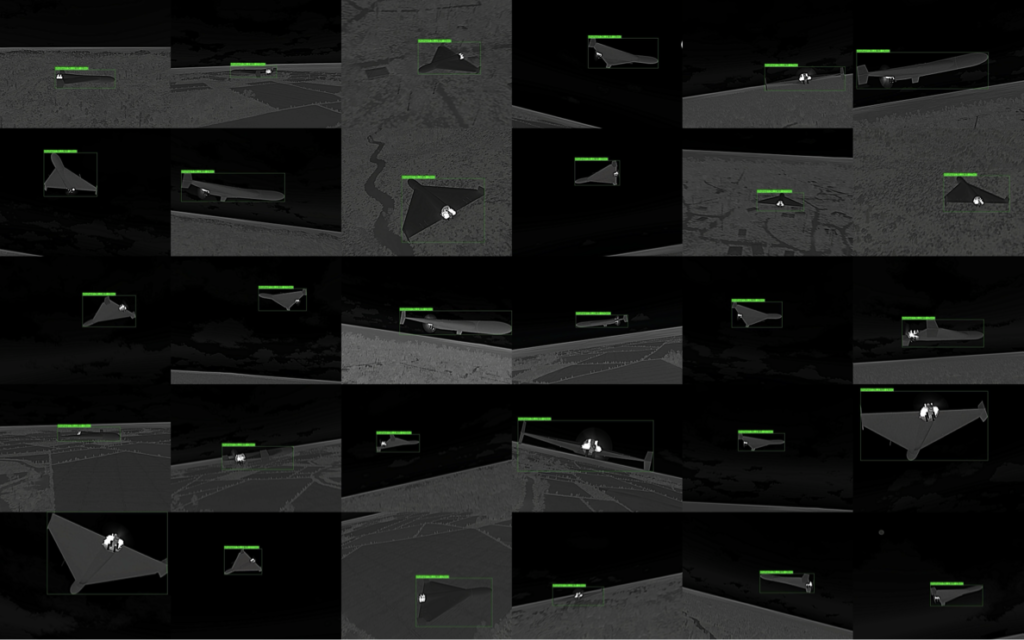
- Defense models: Simulating rare scenarios that cannot be captured traditionally due to security regulations.
By adjusting factors like lighting, occlusion, and object positioning, synthetic datasets ensure better generalization and robustness in AI models.
3. Reducing Bias and Improving Fairness

Real-world datasets often reflect biases in demographic representation, object variability, and environmental conditions. Synthetic data offers control over dataset composition, allowing engineers to:
- Balance representation across gender, age, and ethnicity.
- Normalize environmental, lighting and weather variations in AI.
- Introduce controlled diversity in object detection.
This results in fairer, more inclusive AI models that generalize better across diverse populations and conditions.
4. Privacy Compliance and Security Advantages
In industries like surveillance, defense, and smart home, privacy regulations restrict access to real-world datasets. Synthetic images mimic real-world data distributions without exposing personally identifiable information (PII). This ensures compliance with GDPR, and other data protection laws while still enabling robust AI training.

5. Leading AI Companies Are Already Using Synthetic Data
The adoption of synthetic datasets is no longer theoretical—industry leaders have successfully integrated it into their AI pipelines:
- Waymo trains self-driving car models using a simulated environment called Carcraft, generating countless variations of road conditions.
- NVIDIA Omniverse provides photorealistic virtual environments for AI model training, bridging the sim-to-real gap.
- Mayo Clinic leverages synthetic medical imaging to enhance AI-driven diagnostics while complying with patient privacy laws.
How to Get Your Team on Board
If your team is hesitant, here are actionable steps to encourage synthetic data adoption:
1. Demonstrate ROI with Cost and Efficiency Metrics
Break down the costs associated with collecting, labeling, and managing real-world datasets versus generating synthetic ones. Highlight tangible benefits such as:
- Time savings: Dataset generation in hours instead of months.
- Lower annotation costs: Pixel-perfect labels without manual effort.
- Faster iteration cycles: Models trained and validated more quickly.

2. Conduct a Benchmarking Experiment
Propose a controlled test: Train one model on real-world data and another on a mix of synthetic and real images. Evaluate performance improvements in edge cases and rare event detection. Many teams find that synthetic data enhances model accuracy and generalization.
3. Find an Internal Champion
Identify a team member who understands the challenges of data scarcity and scalability. Work together to run a pilot project showcasing synthetic data’s impact on AI training.
4. Combine Synthetic and Real Data for Best Results
Synthetic data doesn’t need to replace real-world datasets —start with augmenting real-world datasets with synthetic ones. By combining real and synthetic images, teams can mitigate domain adaptation challenges and improve overall model robustness. Then once more trust is build for synthetic image datasets, models can be trained entirely on synthetic datasets.
The Future of AI Training Depends on Synthetic Images
The AI industry is rapidly evolving toward smarter, scalable data strategies. Advances in photorealistic rendering are making synthetic data an indispensable tool for training robust AI models.
Take the First Step:
- Propose a pilot experiment using synthetic data.
- Measure performance improvements in edge cases and bias reduction.
- Future-proof your AI development with scalable, privacy-compliant training data.
The companies adopting synthetic data today will define the next generation of AI innovation!

See How Synthetic Images Transformed Our Weapon Detection Model Training
The Need for Weapon Detection in Today’s Security Landscape In an era where threats evolve rapidly, the demand for cutting-edge security solutions has never been more critical. Weapon detection technology is a foundational in safeguarding public spaces and critical infrastructures, from airports to schools and corporate offices. Advanced security surveillance systems that can accurately detect […]

Why Defense CV Teams Can Never Collect Enough Training Data
Defense and drone CV engineers face a persistent issue: field-collected data falls short for robust models, leaving gaps in edge cases like rare weather or occluded targets. No amount of flights or ground tests delivers the volume, diversity, or labels needed for mission-ready detection. Synthetic data addresses this directly by generating precise, scalable datasets that […]

Presidential Recognition of AI Verse during his address at Adopt AI Summit
We are proud to announce a recognition by French President Emmanuel Macron during his keynote address at the Adopt AI Summit in Paris.President Macron highlighted AI Verse’s strategic partnership with STARK, marking a significant endorsement of the company’s contribution to advancing Europe’s AI capabilities and technological sovereignty. This presidential recognition emphasizes AI Verse’s alignment with […]