
Case Study: Training a C-UAS Detector Using Synthetic Data Alone
AI Verse built the training data a German counter-drone company could not capture: roughly 17,000 synthetic images, generated to its spec across two camera settings and two drone models, labelled to the pixel. On that data alone, its detector reached 0.989 mAP50 on the narrow camera.
The data problem every counter-drone team hits
Counter-drone perception is a data problem before it is a model problem. Detection models need imagery across camera configurations, ranges, drone models, and lighting scenarios. Collecting and annotating that imagery from the real world is expensive, slow, and often impossible. And some requirements cannot be flown at all: the same scene, at the same moment, through two different lenses. Those are the edge cases a detector fails on.
AI Verse closed that gap for a German counter-drone company. We rendered the drone imagery it could not fly, in both camera setups it needed, from the same scene, with pixel-perfect 2D boxes and full 3D pose on every frame. Four batches, each one shaped by the team’s review of the last, from a 50-image sample to full delivery. The company trained and tested its detection models on AI Verse data alone, and never booked a flight.
Narrow and wide angles solved the detection problem
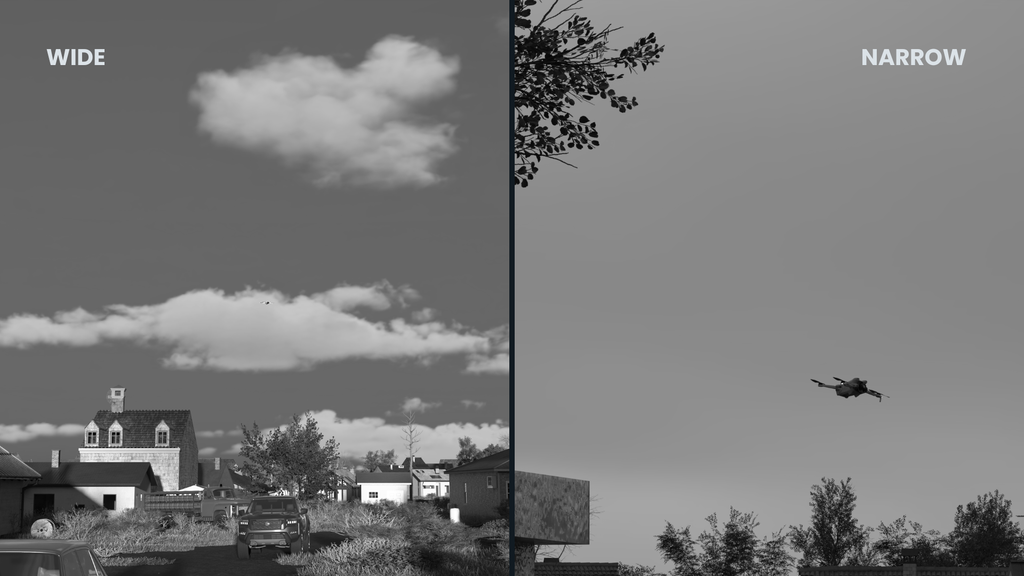
The client needed drone imagery in two simulated camera setups: a narrow long-range view and a wide search-and-acquisition view.
| Camera setting | Resolution | HFOV | Use case |
| Teleobjective / narrow | 2448 x 2048 | 5 deg | Medium-size drone instances |
| Wide-angle view | 5320 x 4600 | 50 deg | Small drone instances, search and acquisition |
The brief was concrete: synthetic images with controllable camera settings, target placement, drone-model variation, and varied lighting and environments. We set the parameters upfront, and every scene had to be shot from both angles at once.
From first sample to full dataset
Good synthetic imagery came from an iteration loop, not one delivery. The requirements were that specific, so the customer’s review of each batch shaped the next. Four steps:
- Initial sample. Around 50 images per camera setting with 2D bounding-box overlays for visual quality control. The customer rated both sets strong and asked for finer labels on the narrow camera.
- Full 3D pose. Instead of fine-grained part labels, AI Verse delivered full 3D pose for the drone with camera intrinsics and extrinsics, and a defined 3D annotation format.
- Second drone model with broader positioning. We added a second drone model and spread target positions much more widely across the wide-angle frame.
- Full delivery. Roughly 17,000 images in four batches of about 4,250, two drone models, two cameras, all matching the approved sample.
Change the spec, regenerate, ship. No new capture campaign, no new labelling team.
Achieved near-perfect results on the narrow camera
On the teleobjective setting, where the drone appears as a medium-size target, YOLO training on the synthetic data detected it reliably.
| Metric | Teleobjective (narrow) | Wide-angle (search) |
| mAP50 | 0.989 | 0.568 |
| mAP50-95 | 0.885 | 0.269 |
Best reported run: 0.989 mAP50 and 0.885 mAP50-95, with precision 0.989 and recall 0.986, in 9.52 hours of training. Other teleobjective runs came close, at mAP50 0.976 to 0.981.
Tiny targets were the hard case
The wide-angle setting is harder by design. A 50-degree field of view makes each drone far smaller. The customer trained a dedicated small-object architecture on the AI Verse data, using 1280-px training, NWD loss, SPD convolution, and a P2 head, and reached 0.568 mAP50 on the medium model.
Wide-angle scores are lower, as the target size predicts. Even so, the customer trained and tested a small-object detector on synthetic data alone.
From synthetic frames toward the field
One pipeline covered both jobs: medium-object detection on the narrow camera, small-object detection on the wide-angle camera. The customer trained on zero real images.
The customer also reported early use of the synthetic-trained models in a targeting-system demonstration. That report is internal and awaits customer approval, so treat it as a hint, not a published claim.
Trained on zero real images. Best narrow-camera result: 0.989 mAP50 and 0.885 mAP50-95.
Why synthetic imagery works
Collecting and labelling real images takes months. Here the client needed the same scene from a narrow and a wide angle, which rules out almost all imagery already shot. The AI Verse engine adapts fast to what a customer asks for, and our team works with them until it matches every parameter they set. So the customer gets photorealistic synthetic datasets for computer vision training, fast. Every image comes labelled to the pixel, so label quality holds as volume grows.
NATO DIANA chose AI Verse as one of the top 70 deeptech defence companies from more than 3,000 applicants. AI Verse is also the first company under contract with Amiad, the French ministerial agency for defence AI.

Train Computer Vision Models to See Through Fog
In the real world, vision doesn’t stop when the weather turns. But for many computer vision models, fog is enough to break perception entirely. The haze that softens the landscape for human eyes becomes a severe challenge for machine vision—reducing contrast, scattering light, and erasing the fine edges that models rely on to make sense […]
How Automated Annotation with Synthetic Data Elevates Model Training in Computer Vision
Automated annotation is the process of generating ground truth labels for training data — bounding boxes, segmentation masks, keypoints — without manual human input. With synthetic images, every annotation is produced automatically at the moment of image creation, making it possible to build fully labeled datasets at machine speed and unlimited scale. What is automated […]

Synthetic Data vs. Real-World Data: A Game Changer for AI Model Training
In the realm of AI and machine learning, the debate between synthetic datasets and real-world images is a pivotal one. Both have their merits, but when it comes to efficiency, flexibility, and performance, synthetic data is emerging as the clear frontrunner. Let’s explore why. Speed, Cost, and Flexibility: The Case for Synthetic Data Building a […]