
Real-Life Data vs. Synthetic Data: How Computer Vision Engineers Allocate Their Time
Computer vision engineers are at the forefront of teaching machines to “see” and understand the world. Their daily practices, and ultimately the pace of AI innovation, are shaped by the kind of data they use—either real-life imagery painstakingly collected from the physical world, or synthetic data generated by advanced simulation engines.
Let’s examine how these differences define the daily workflow in computer vision, highlighting the distinct advantages and opportunities offered by each.
The Real-Life Data Engineer
Key Responsibilities:
- Acquiring real-world images and videos
- Cleaning and annotating data, often by hand or via crowd-sourcing
- Designing and developing computer vision models
- Validating models against real scenarios and edge cases
- Addressing data quality, privacy, and edge case challenges
Typical Time Allocation:
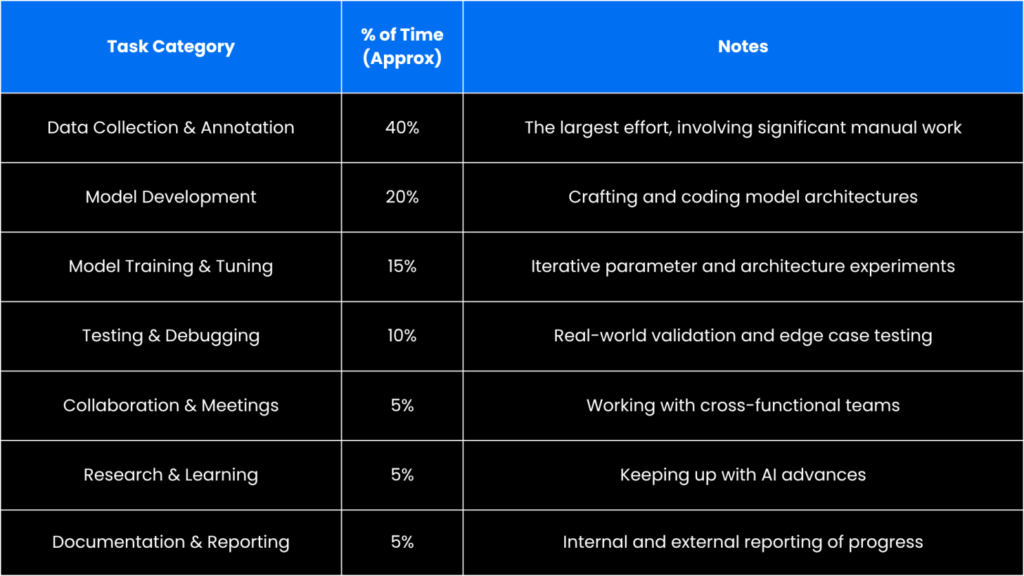
Why So Much Time On Data?
Real-world data, while richly detailed, comes with inherent complexity. Each image must be collected, cleaned, and meticulously annotated. Privacy, data diversity, and edge-case identification further increase the effort needed to achieve robust computer vision results.
The Synthetic Data Engineer
Key Responsibilities:
- Generating large, diverse synthetic datasets using advanced procedural and simulation engines such as AI Verse’s Gaia
- Validating and curating synthetic datasets for relevance and completeness
- Training AI models on pixel-perfect, automatically labeled synthetic images
- Applying domain adaptation techniques to ensure strong real-world performance
- Iteratively refining both datasets and models for optimal coverage and quality
Typical Time Allocation:
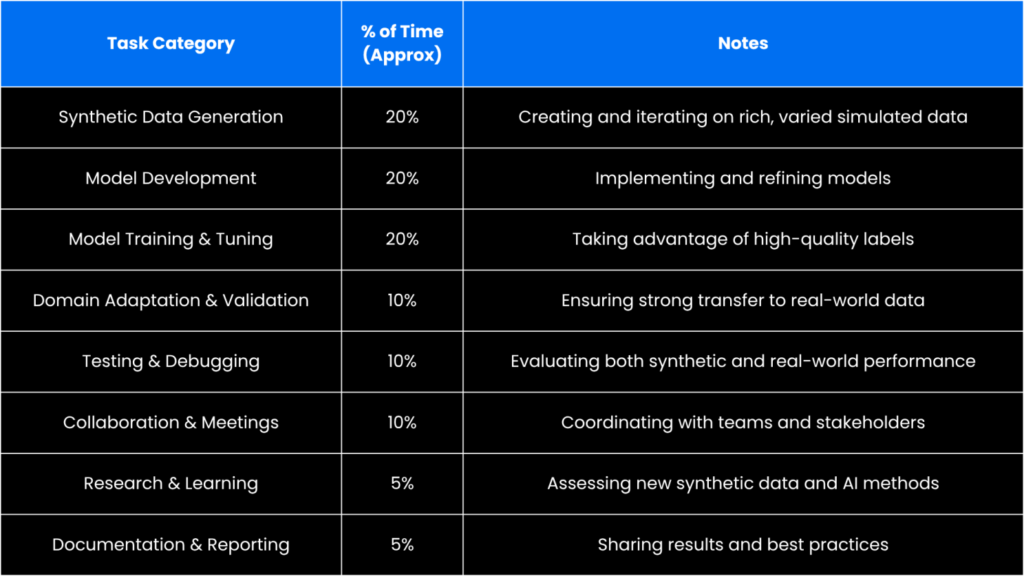
What Sets Synthetic Data Apart?
Engineers using synthetic data are empowered by high-fidelity simulation tools that allow them to automatically generate and label image data at massive scale. This eliminates the need for manual annotation, freeing up time for developing, tuning, and validating advanced models. The result is a more efficient AI training that accelerates innovation and enables comprehensive coverage, including rare and safety-critical scenarios difficult to capture in the real world.
Side-by-Side Comparison
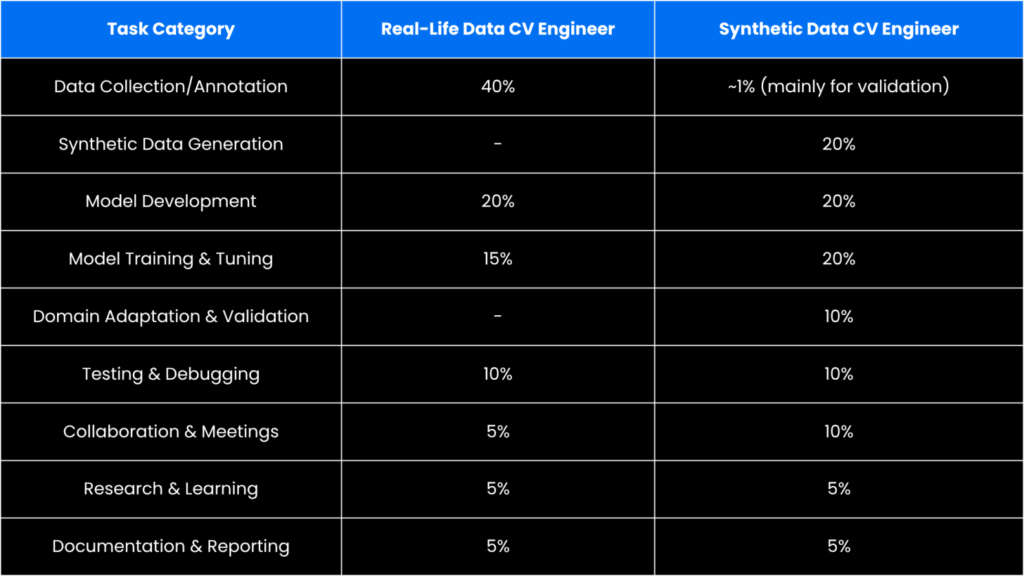
Why More Teams Choose Synthetic Data
Synthetic data offers a transformative approach to computer vision:
- Efficient, scalable, and diverse dataset generation—enabling rapid iteration and innovation.
- Comprehensive coverage of rare and challenging scenarios, ensuring robust model performance across use cases.
- Bypassing privacy constraints—synthetic assets are customizable and inherently anonymous.
- Automated, pixel-perfect labeling eliminates manual annotation, maximizing engineering productivity.
- Flexible domain adaptation and validation processes that ensure high performance when deployed in the real world.
Both real-world and synthetic data demand high-level collaboration, technical excellence, and continuous learning. However, synthetic data empowers engineers to focus more on driving model accuracy, expanding use case coverage, and accelerating the path from idea to deployment.
As AI advances and applications expand, synthetic images are proving crucial for boosting model accuracy, coverage, and development speed. For companies building computer vision solutions, the synthetic-first approach opens new possibilities—delivering the data needed to fuel the future of intelligent machines.
Data source: AI Verse survey of computer vision engineers (2025). Time allocation figures represent median responses across teams using traditional real-world data collection pipelines versus synthetic data generation workflows.

2025 Will Be the Year of Computer Vision for These Industries
As industries gear up for 2025, computer vision is emerging as a transformative force across sectors, with its ability to interpret and analyze visual data at unprecedented levels. From enhancing public safety to optimizing retail operations, this technology is driving innovation and efficiency in ways that were once unimaginable. Let’s explore industries that will be […]

Presidential Recognition of AI Verse during his address at Adopt AI Summit
We are proud to announce a recognition by French President Emmanuel Macron during his keynote address at the Adopt AI Summit in Paris.President Macron highlighted AI Verse’s strategic partnership with STARK, marking a significant endorsement of the company’s contribution to advancing Europe’s AI capabilities and technological sovereignty. This presidential recognition emphasizes AI Verse’s alignment with […]
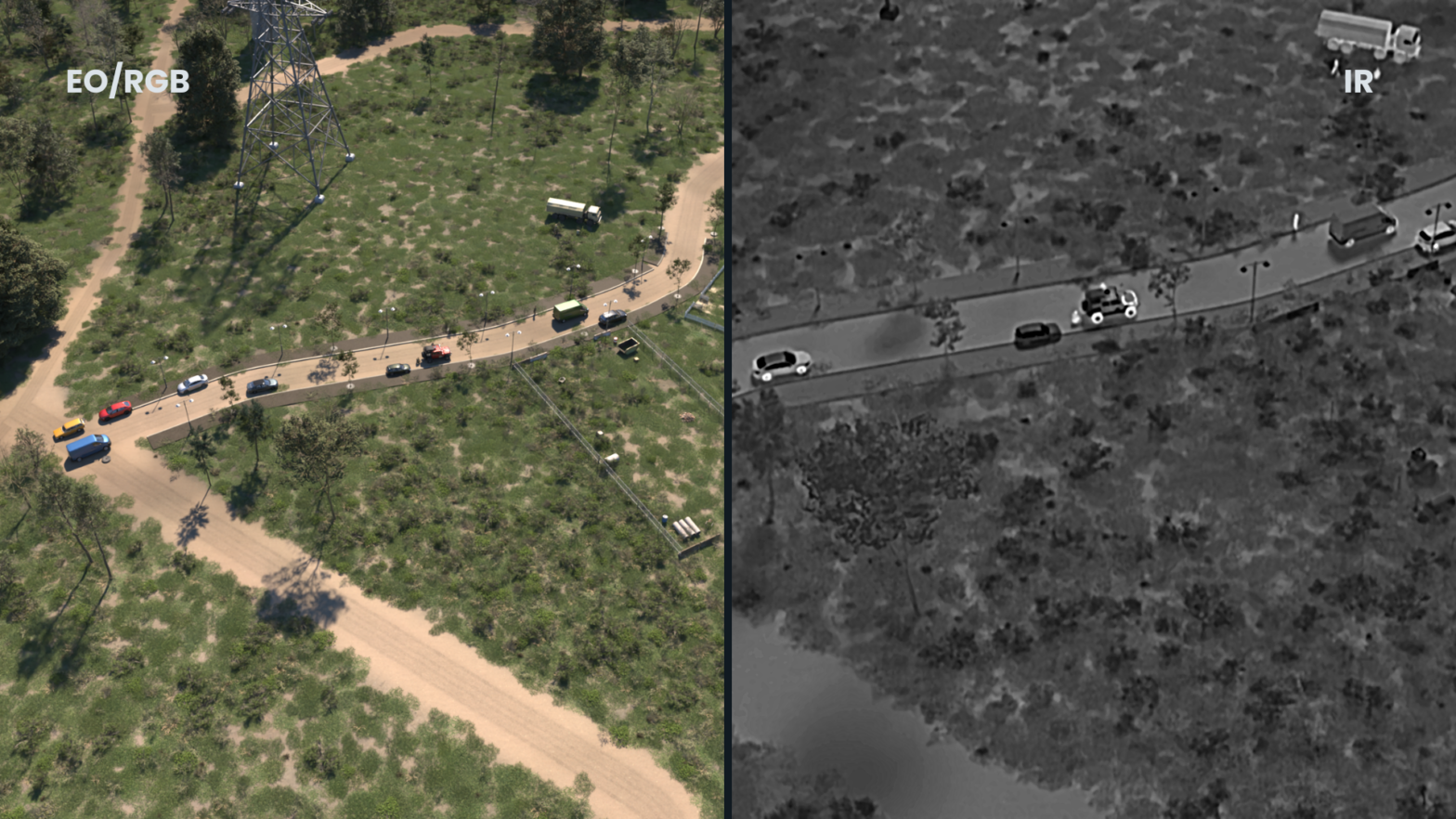
Case study: synthetic EO/IR training data lifts vehicle detection by +5.4 AP
AI Verse generated 30,000 images of synthetic EO/IR training data for a leading German drone manufacturer. Added to the customer’s own training data, they lifted vehicle-detection AP by 5.4 points on EO and 2.94 points on IR. The EO gain beat the +3 mAP benchmark set by an earlier AI Verse project. The challenge: EO […]